Chiesi - AI Pharmacovigilance Literature Analysis System
Project Overview
An intelligent literature analysis system designed for pharmacovigilance (PV). It automates medical literature screening to identify company products and assess safety information, supporting compliance and patient safety while significantly reducing manual review workload.
Industry Pain Points
High Volume of Literature
Pharmacovigilance teams must monitor a vast amount of global medical literature daily. Manual screening is labor-intensive and inefficient.
Risk of Missed Safety Signals
Identifying adverse drug reactions (ADRs) and special situations (e.g., overdose, pregnancy use) requires high precision. Manual review runs the risk of missing critical safety signals.
Standardization & Traceability
PV regulatory requirements are strict. Manual processes often lack consistent scoring standards and traceable audit trails for decision-making.
Innovative Solution
Core Methodology
The system employs a multi-stage AI pipeline to process literature:
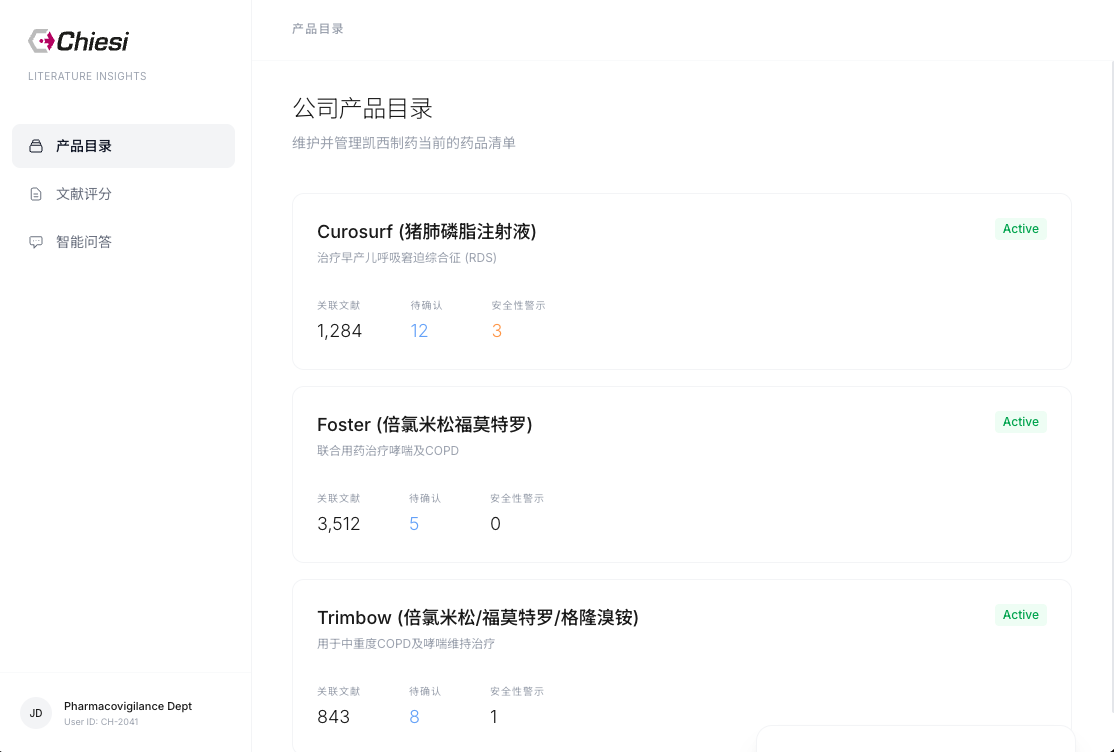
- Automated Retrieval & Matching: Automatically retrieves literature metadata via APIs and matches records against the company's product catalog.
- AI Relevance Scoring: The system downloads PDFs and uses NLP to analyze content, learning from historical data to calculate a relevance score (0-100%) for each article regarding company products.
- Safety Signal Detection: Automatically identifies "Safety Information" (e.g., side effects).
* Uncertain: Triggers a "Human-in-the-loop" workflow, sending email alerts with the document ID and reasoning to experts for manual review.
Technical Implementation
- AI-Driven Analysis: Uses large language models (LLMs) to perform semantic analysis on full-text PDFs.
- Active Learning: The scoring engine iteratively improves by learning from 100% relevant historical cases, capturing context patterns and keywords.
- Intelligent Assistant: Integrates an AI agent architecture with MCP (Model Context Protocol) to enable natural-language semantic search and Q&A across the literature database.
Value Delivered
- Efficiency: Automates the initial screening of thousands of documents, allowing experts to focus only on high-risk or uncertain cases.
- Compliance: Reduces the risk of missed safety signals through rigorous AI scanning and automated alerting.
- Agility: The semantic search capability allows teams to quickly retrieve specific safety data or historical cases using natural language.